

(Ref. No. SA-040)
Student almost killed using “home-made” cylinder rod extraction apparatus in hydraulics lab -
By Rory S. McLaren - Director
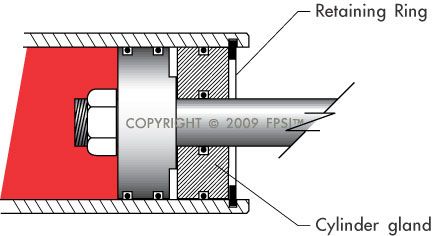
The students apparently removed the gland retainer and initially attempted to remove the rod by laying the cylinder on the floor and attempting to slide the rod and gland out. They were unsuccessful because the gland appeared to be seized in place. It needed more force than they could project to remove the stubborn gland.
With the instructor’s help they constructed a device that they were certain would create sufficient force to extricate the stubborn rod gland. They started out with a large, flat piece of steel to which they welded an anchor. They secured the closed end of the cylinder to the anchor with a chain.
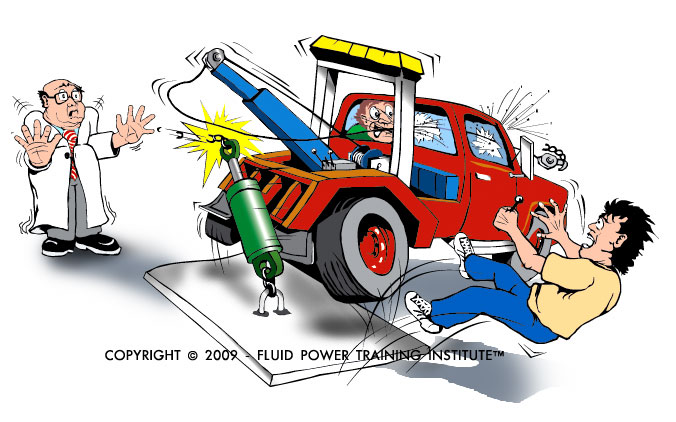
The students, aided by their instructor, attached the cable’s hook to a chain, which they had fastened to the cylinder’s clevis. The cylinder rod extraction apparatus was complete and the task of removing the rod was ready to begin.
One student sat in the driver’s seat, while another operated the valves, which were located at the rear end of the tow-truck. The other students watched intently as their experiment moved from planning to execution. One lucky student was assigned the task of operating the winch while another was given the task of sitting in the truck’s drivers seat and holding his foot on the brake.
The winch started to rotate slowly when the student activated the lever. The tough winch lifted the cylinder into the vertical position readying it for pulling action.
The silence was broken by a thunderous explosion, which occurred when the chain connecting the tow-hook to the rod eye unexpectedly snapped. The action of the vehicle bouncing up, the tires springing back to normal, and the cable losing its tension, caused the cable and hook assembly to recoil violently. The “projectile” unraveled from its sheave and took off in the direction of the vehicles rear window – through which the horrified student was peering.
The students watched helplessly as the projectile sailed through the vehicles rear window and out through the front window. The student sitting behind the wheel froze as the steel projectile flew through the cab – missing his face by mere inches – glass shards became themselves miniature projectiles popping as they struck every inch of the inside of the cab. The broken hook assembly came to rest over the end of the tow-truck’s hood with the cable stretching from the winch through the vehicle’s cab and over the hood.
The student, along with his classmates and the instructor, were fortunate to survive the incident without injury. The lesson in “trial-and-error” was over. The lesson wasn’t a complete failure however, as the students did learn how NOT to disassemble a hydraulic cylinder. Had the procedure been successful in freeing the gland, the students would have probably graduated from college having mistakenly learned that constructing a makeshift mechanism without knowing the strength of the relative materials is the correct way to remove a stubborn gland from a cylinder. Thus perpetuating unsafe maintenance practices throughout the industry and creating multitudes of 'accidents waiting to happen!'
“Fluid power safety doesn’t just happen, it has to be pursued."
The Fluid Power Safety Institute™ presents “safety-based” hydraulic workshops on a regular basis. You can find our training schedule at www.fpti.org
Rory S. McLaren
Founder/Director
Fluid Power Safety Institute™
BACK
About the FPSI™ | Safety Alerts | FPSI™ Resources | Safety Products | Industry Safety Links | Family/Community Safety | Site Map | Contact FPSI™ | HOME
Copyright © 2002-2009 - FPSI™
